Clay Crafts That Can Actually Make Money
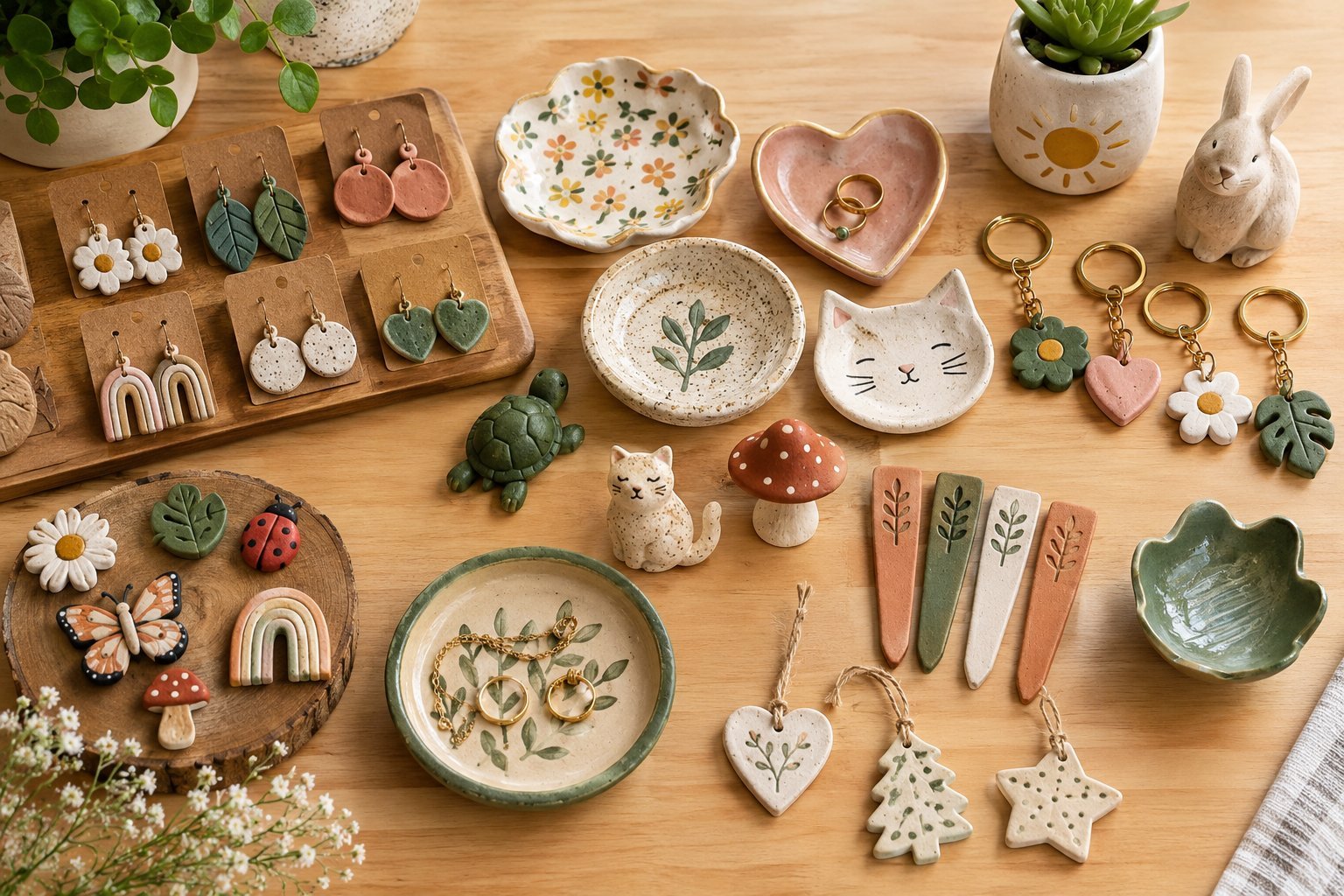
When I started looking at clay crafts as something that could bring in extra income, I quickly realized that making something beautiful was only part of the process.
A craft can look amazing and still be difficult to sell if it takes too long to make, costs too much in supplies, or does not offer enough value to the customer.
I have found that the clay projects with the most potential are usually small, useful, giftable, customizable, or easy to produce in batches. Those qualities make a big difference when you are trying to turn a creative hobby into a small business.
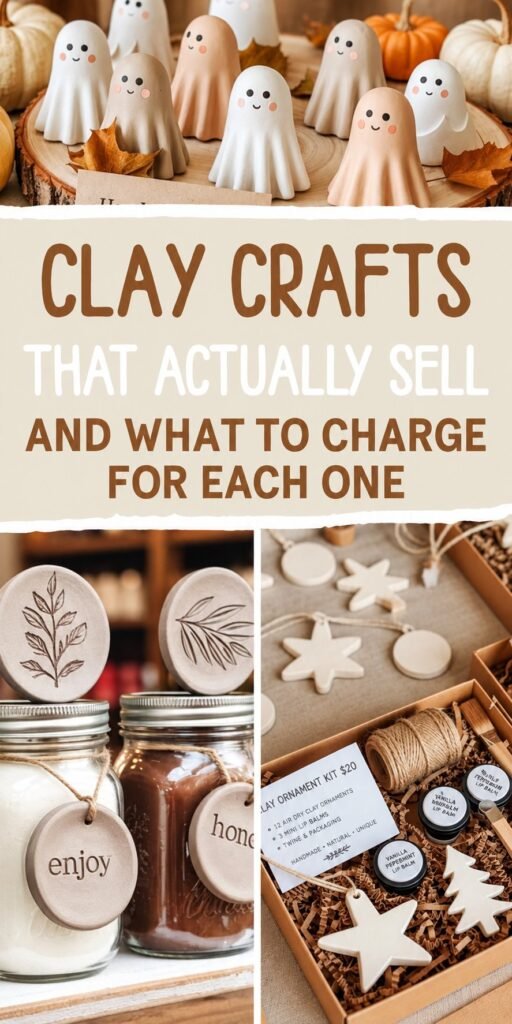
I also pay close attention to the time involved because pricing only the clay and supplies can leave you doing a lot of work for very little profit. In this guide, I am sharing clay crafts that can work well for selling, along with the pricing approach I would use for each project.
My goal is to help you choose projects that are enjoyable to make while also giving you a realistic starting point for building a profitable handmade craft collection.
What Makes a Clay Craft Worth Selling?
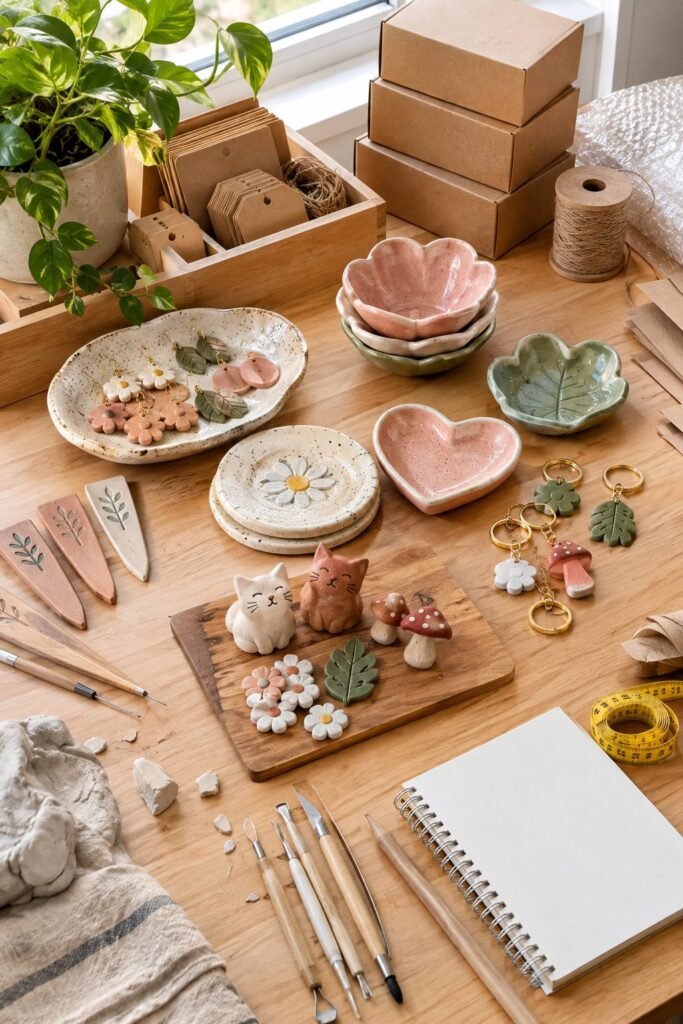
Before choosing a clay project to sell, I like to look at more than how attractive the finished piece is.
A good product needs to make sense from a business perspective. The materials should be affordable enough to leave room for profit, the process should be repeatable, and the finished item should have enough perceived value for someone to pay more than the basic material cost.
I also pay close attention to personalization.
Names, initials, colors, dates, simple messages, birth flowers, and custom shapes can turn an ordinary clay item into something much more meaningful. Personalization can also give you more room to charge for your time because the customer is not simply buying something that could have been made for anyone.
Another thing I consider is how easy the product will be to package and ship.
Small clay crafts are often easier to sell online because they do not require large boxes, expensive packaging, or complicated shipping arrangements. They can also make excellent gifts, which gives you another reason for customers to purchase them.
Before adding a project to your collection, I would look at four basic numbers.
Material cost
Time required
Packaging cost
Selling price
Your profit comes from what remains after all of those costs are considered.
1. Clay Trinket Dishes
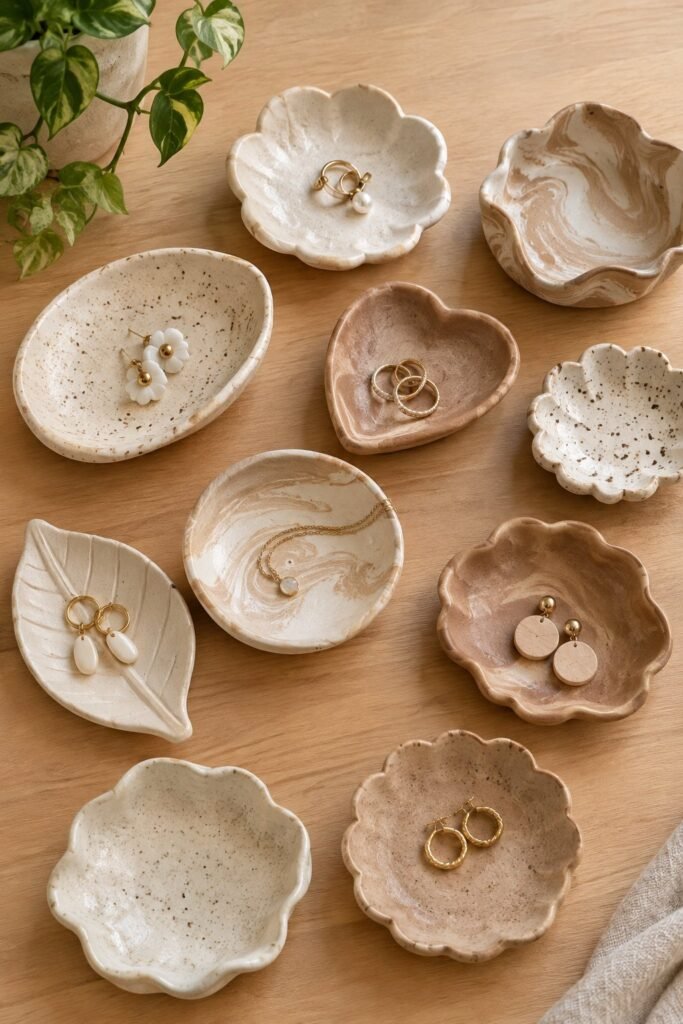
Clay trinket dishes are one of the projects I would consider when building a handmade clay collection because they are simple enough to make in different styles without requiring an overly complicated process.
You can make small dishes for rings and earrings or slightly larger versions for keys, coins, hair clips, and other small items.
I like keeping the shapes relatively simple because the finish can do much of the work. A clean organic shape with an attractive color combination can make a small piece look much more expensive than the amount of clay used to create it.
You can also create collections instead of producing every dish as a completely different design.
For example, you could have a neutral collection using cream, beige, white, and brown tones. You could create another collection with brighter colors or experiment with marbled patterns, speckles, pressed textures, and painted details.
This gives customers a reason to purchase more than one.
Pricing Tip
I would calculate the complete cost before deciding on a selling price.
If the clay and other materials cost around $2 and packaging costs another $1, your basic material and packaging cost is already $3.
You still need to account for your time.
If the complete process takes 30 minutes, that time has value even if you are making the item at home.
Depending on the size, finish, customization, and presentation, a handmade clay trinket dish could be positioned around $10 to $25 or more.
A personalized dish can be priced higher than a basic version because the customer is paying for the additional customization.
2. Clay Earrings
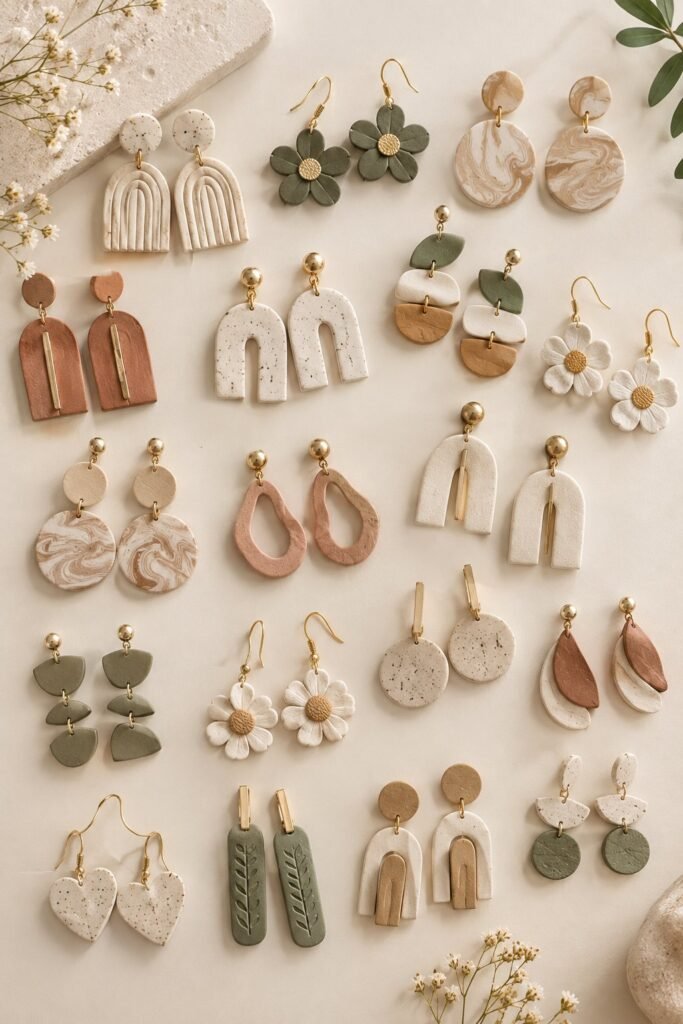
Clay earrings are another product I would consider when looking for something small, lightweight, and relatively inexpensive to ship.
One of the biggest advantages is the number of designs you can create from a relatively small amount of clay.
You can make arches, circles, flowers, leaves, abstract shapes, geometric designs, and layered earrings. Once you have a few reliable shapes, you can experiment with different color combinations without completely changing your production process.
I would focus on creating a recognizable style rather than making every pair completely different.
For example, you could build a collection around neutral colors and simple shapes. Another collection could focus on colorful statement pieces.
Once you have a few designs that are quick to reproduce, batch production becomes much easier.
I would prepare several pairs at once, complete the clay work together, cure them, add the earring findings, inspect each pair, and then package them.
That approach can save a considerable amount of time compared with completing one pair from beginning to end before starting another.
Pricing Tip
The clay used for one pair might cost very little, but that does not mean the earrings should be priced cheaply.
You need to consider the clay, earring findings, packaging, finishing supplies, your time, selling platform fees, and other business expenses.
A simple handmade pair could start around $12 to $20, while detailed statement designs or personalized pieces can be priced higher.
I also like having different price levels within a collection.
Simple designs can sit at the lower end, while more detailed designs can command a higher price.
That gives customers options while allowing you to earn more from pieces that require additional work.
3. Personalized Clay Keychains
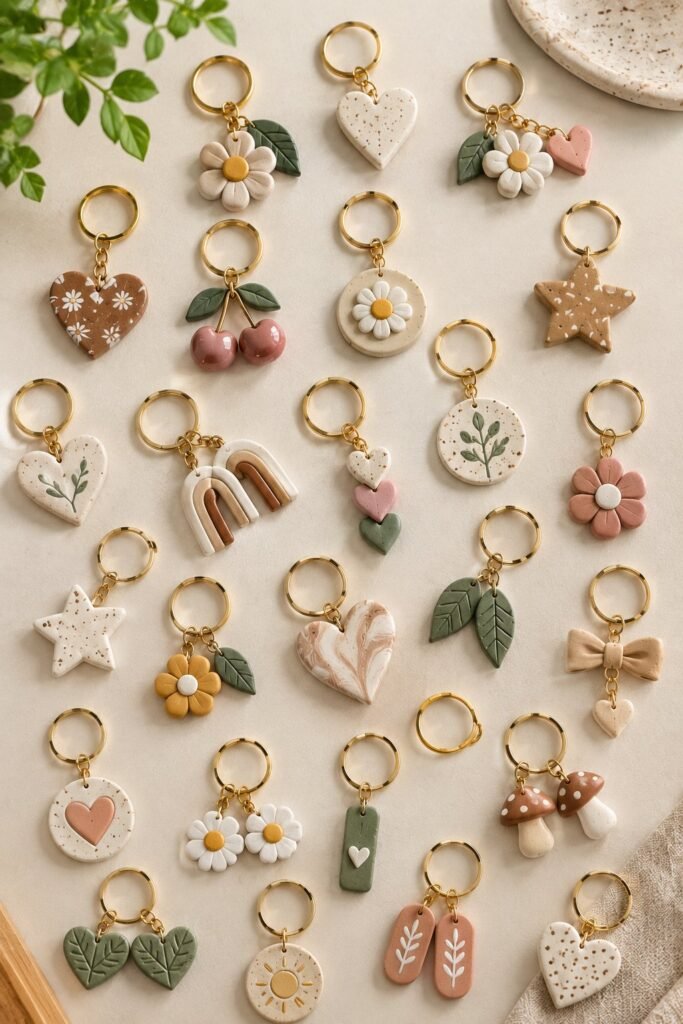
Personalized clay keychains can be a strong option because they are small, giftable, and easy to customize.
Names and initials are particularly useful.
You can create letter keychains, small flowers, hearts, stars, animals, food shapes, simple tags, or other designs that can be customized with different colors and initials.
I would keep the designs relatively small because a keychain needs to remain practical. A large or heavy piece may look attractive but can become inconvenient to carry.
Another advantage is that keychains can be produced in batches.
Instead of making one keychain completely before beginning the next, I would prepare several pieces together, add the details, cure them, attach the hardware, inspect them, and package the finished products.
That makes the production process much more efficient.
Pricing Tip
A basic handmade clay keychain could be priced around $7 to $15, depending on its size, materials, and design.
Personalized versions can be priced higher.
If a customer wants a name, special color combination, custom shape, or another personal detail, I would treat that as additional work rather than including it for free.
A small customization fee can make a noticeable difference to your profit when you receive several custom orders.
4. Clay Magnets
Clay magnets are another project I like because they can be produced in batches and sold as individual pieces or collections.
Instead of creating one large decorative item, you can make several small designs around a common theme.
Flowers, fruit, coffee cups, mushrooms, stars, plants, animals, seasonal designs, and simple kitchen shapes can all work as starting points.
You could sell one magnet individually, but I would also experiment with sets.
A customer who might hesitate to spend $8 on one small magnet may be more interested in purchasing a coordinated set of four or six.
Sets can also increase the value of each order without requiring you to develop an entirely different product.
Pricing Tip
A single handmade clay magnet could be priced around $4 to $8, depending on the size and amount of detail involved.
You could also offer sets of three, four, or six.
For example, a set of four could potentially sit around $15 to $25, depending on your material costs, production time, packaging, and the level of detail.
The important part is to calculate the numbers before creating a discount.
A bundle should increase the total value of the order without reducing your profit to the point where the additional sales are not worthwhile.
5. Clay Ring Cones
Clay ring cones are another small product that can work well as both a practical item and a decorative piece.
The shape is simple, but the finished product can be made more interesting through color, texture, small patterns, or personalization.
I particularly like this type of project for gift collections because it pairs naturally with other small clay products.
You could create a ring cone alongside a matching trinket dish and sell them individually or as a small jewelry storage set.
This gives you another opportunity to increase the average order value without having to create a completely new type of customer.
Pricing Tip
A simple clay ring cone could sit around $8 to $18, depending on its size, finish, and level of detail.
A personalized version could be priced higher.
If you are creating a matching set, calculate the cost of producing each individual piece before deciding how much of a bundle discount you can comfortably offer.
6. Clay Hair Clips and Barrettes
Clay can also be used to create decorative hair accessories.
This category gives you plenty of room to experiment with colors, patterns, flowers, geometric shapes, and seasonal designs.
The key is making sure the clay component is securely attached to the hair accessory and that the finished piece remains comfortable and practical.
I would also pay attention to weight.
A beautiful hair clip that feels too heavy or awkward is unlikely to become a repeat purchase, so I would test each design before adding it to the shop.
Pricing Tip
Simple handmade clay hair clips could start around $8 to $15, while more detailed or personalized pieces could be priced higher.
Sets can also work well here.
A coordinated set of two or three clips can feel more valuable to customers than a single piece, while allowing you to produce several items during the same crafting session.
How I Calculate the Price Before Selling a Clay Craft
One of the biggest mistakes I would avoid is pricing a handmade product according to the cost of the clay alone.
Your clay may only cost a couple of dollars, but the finished product represents much more than the raw material.
I like to think about pricing this way:
Materials + packaging + labor + business expenses + profit = selling price
For example, imagine that a clay product uses $2 worth of materials and costs $1 to package.
If it takes 30 minutes to make and you value your time at $15 per hour, your labor represents another $7.50.
That means the basic cost is already $10.50 before considering selling fees and other expenses.
Selling that item for $8 would mean you are effectively paying yourself to make it.
That is why I always recommend calculating your time before deciding whether a product is actually profitable.
Test the Craft Before Making It a Main Product
Before producing dozens of one design, I would make a small test batch.
Make three to five pieces and time yourself.
Write down how much clay and other supplies you use.
Record the packaging cost.
Then calculate the price you would need to charge to make the project worthwhile.
This also gives you an opportunity to notice problems with the design.
Maybe the first version takes too long to shape. Maybe the finishing process is more complicated than expected. Maybe the packaging needs to be stronger than you originally planned.
Finding those problems while you are making five pieces is much easier than discovering them after you have produced fifty.
The goal is not simply to find clay crafts that people might buy. The goal is to find products that you can make consistently, price properly, package safely, and sell while still earning from your time.
That is what turns a fun clay project into something that can actually function as a small handmade business.
More Clay Crafts to Make and Sell
Once you have a few simple clay products figured out, I would start looking at crafts that give you more room to charge for customization, detail, and gift appeal.
This is where clay becomes especially interesting because small changes in color, shape, texture, and personalization can create completely different products without requiring an entirely new set of supplies.
I also like products that can be grouped into collections. A customer who comes across one handmade item they love may be interested in matching pieces, seasonal versions, or a personalized variation. That gives you more opportunities to increase an order without constantly searching for completely new products.
7. Clay Ornaments
Clay ornaments can be a great seasonal product because you can change the designs throughout the year.
Christmas ornaments are an obvious option, but you do not have to limit yourself to December. You can make wedding ornaments, baby name ornaments, new home ornaments, birthday decorations, memorial pieces, and personalized ornaments for special occasions.
I would put particular attention into personalization because that is where a simple clay ornament can become a meaningful keepsake.
Names, dates, short messages, initials, and simple illustrations can all make the finished piece feel more personal.
Another approach I like is creating a few standard shapes and changing the decoration rather than creating an entirely new shape for every order.
That keeps production manageable while still giving customers plenty of choices.
Pricing Tip
Simple clay ornaments could start around $8 to $15.
Personalized ornaments can reasonably be priced around $12 to $25 or more, depending on the amount of customization.
If you are making detailed designs by hand, make sure your price reflects the additional time.
A personalized ornament that takes 20 minutes longer to complete should not cost the same as a basic ornament simply because they use approximately the same amount of clay.
8. Clay Candle Holders
Small clay candle holders can make attractive home decor pieces and give you more room to experiment with textures and finishes.
I would keep the designs simple and focus on creating pieces that look intentional.
Neutral colors, organic shapes, speckled finishes, and subtle textures can work particularly well for handmade home decor.
Safety is important with this type of product.
The design needs to be appropriate for its intended candle and should not place flammable materials too close to an open flame. If you are making pieces from a particular type of clay, follow the manufacturer’s instructions for curing and intended use.
You should also clearly explain how the product is intended to be used rather than assuming customers will automatically understand its limitations.
Pricing Tip
Small handmade candle holders could fall around $15 to $30, depending on size, design, finish, and production time.
More detailed pieces can command more, but I would always calculate your actual labor before setting the price.
Home decor buyers are often paying for the overall appearance and craftsmanship, not simply the amount of clay in the product.
9. Clay Plant Markers
Clay plant markers are a practical product that can also make a lovely gift.
You can create labels for herbs, vegetables, flowers, and indoor plants.
The designs can be very simple, which makes them suitable for batch production.
You could make a standard collection with labels such as basil, rosemary, mint, parsley, tomato, and lavender.
You could also offer blank markers for customers who want to write their own plant names.
I would consider selling these in sets because gardeners often need multiple markers at once.
Pricing Tip
A single handmade plant marker could be priced around $4 to $8.
A set of six could potentially sit around $20 to $35, depending on your materials and design.
The advantage of selling a set is that you can produce several pieces during one session while increasing the total value of each order.
Just make sure the set price still accounts for your labor.
10. Clay Bookmarks
Clay bookmarks are another small product that can be personalized and marketed as a gift.
You can create slim designs with small decorative elements, initials, flowers, stars, hearts, or other details.
I would avoid making them unnecessarily thick because the finished bookmark should still sit comfortably inside a book.
This is also a product where color collections can work nicely.
You could have neutral bookmarks, floral designs, seasonal designs, or personalized versions.
Pricing Tip
A handmade clay bookmark could be priced around $8 to $15.
Personalized versions could sit closer to $12 to $20, depending on the amount of detail.
I would also consider offering a bookmark with another small clay product as a gift set.
For example, a bookmark and matching keychain could create a simple gift collection without requiring a completely new production system.
11. Clay Magnets for Special Occasions
Rather than limiting magnets to everyday decorative pieces, you can create them for specific events.
Wedding favors, birthday parties, bridal showers, baby showers, housewarming gifts, and holiday gatherings can all create opportunities for bulk orders.
This is one area where I would focus heavily on consistency.
If a customer orders 30 personalized magnets, they need to look like they belong to the same collection.
I would make one sample first and use it as the standard for the entire order.
This also makes it easier to calculate your production time.
Pricing Tip
For bulk orders, I would calculate your price per piece after determining exactly how long it takes to make one item.
A simple personalized clay magnet might sell for around $5 to $10 per piece for smaller individual orders.
Bulk orders may have a lower per-piece price because the customer is buying a larger quantity, but the total order can still be worthwhile because you are producing multiple pieces together.
For example, you might charge more per piece for an order of five and offer a lower per-piece rate for an order of thirty.
The important thing is making sure the bulk discount does not remove your profit.
12. Clay Incense Holders
Clay incense holders can be another interesting home decor product.
The designs can range from very simple holders to more decorative pieces with textured surfaces and sculpted details.
I would focus on creating designs that look attractive even when they are sitting unused.
That matters with home decor because the customer is buying something that will remain visible in their space.
You should also make sure the finished product is properly cured and appropriate for its intended use, following the instructions for the clay you are working with.
Pricing Tip
A small handmade incense holder could be priced around $10 to $25.
More detailed sculptural designs can sit higher if the production time and craftsmanship justify the price.
This is another product where presentation matters.
A well photographed, neatly packaged handmade piece can communicate considerably more value than the same item presented without much attention to its finishing details.
13. Clay Coasters
Clay coasters are useful because they combine home decor with everyday functionality.
You can make round, square, organic, floral, terrazzo style, or textured designs.
I would strongly consider selling them as sets rather than focusing only on individual coasters.
A set of four immediately feels more like a complete home product.
You can also create different collections around color combinations.
For example, one collection could use neutral tones while another could use brighter colors.
Pricing Tip
A handmade coaster could be priced around $6 to $10 individually, depending on the materials and design.
A set of four could sit around $25 to $45.
Before choosing the final price, calculate how long it takes to make four coasters from start to finish.
If the entire set requires several hours of work, a $20 price may not make sense even if the materials are inexpensive.
14. Clay Jewelry Dishes
Clay jewelry dishes are similar to trinket dishes, but you can position them specifically as jewelry storage.
This gives you another opportunity to build a coordinated product line.
You could create small dishes for rings and earrings, larger dishes for necklaces and bracelets, or matching sets for customers who want several pieces.
Personalization can work particularly well here.
A simple initial, name, flower, or meaningful date can turn a basic jewelry dish into a personalized gift.
Pricing Tip
A small jewelry dish could start around $12 to $20.
Larger or more detailed pieces could reach $25 to $40 or more.
If you are selling a personalized version, calculate the additional time required before deciding how much extra to charge.
I would rather charge appropriately for customization than spend extra time on every order without seeing that work reflected in the price.
15. Clay Miniature Decor
Small clay sculptures and miniature decorations can become some of the more creative products in your collection.
You can make tiny mushrooms, flowers, fruits, houses, books, food shapes, plants, animals, or other decorative objects.
The possibilities are almost endless.
The main thing I would watch is production time.
A miniature piece may look small and simple while actually requiring much more work than a larger basic item.
This is why I would not automatically price miniature crafts cheaply.
The size of a product does not determine its value.
The time, skill, detail, materials, and demand all matter.
Pricing Tip
Small clay decorations could range from $8 to $30 or more, depending on the complexity.
If a miniature sculpture takes an hour to create, it should not be priced like a five minute project simply because it is physically small.
This is one of those situations where tracking your time can completely change the way you think about pricing.
16. Personalized Clay Name Plates
Personalized name plates can be made for bedrooms, desks, shelves, craft rooms, nurseries, offices, and other spaces.
This type of project has strong customization potential because the customer can choose a name, color combination, shape, and decorative style.
I would create a few standard templates rather than starting from scratch for every order.
For example, you could offer a floral design, a minimalist design, a colorful design, and a children’s design.
Customers can then choose their preferred style and provide the name they want added.
That gives them customization without turning every order into a completely new project.
Pricing Tip
A small personalized clay name plate could start around $15 to $30, with larger and more detailed versions priced higher.
Make sure your listing clearly explains what customization is included.
If adding extra characters, decorations, or special colors requires additional work, make those options separate upgrades rather than quietly absorbing the extra labor.
How to Make Your Clay Products Feel More Valuable
One thing I have learned with handmade products is that customers do not judge value by the material alone.
Presentation matters.
A simple clay item can feel considerably more special when it has a consistent design, clean finishing, thoughtful packaging, and clear product photography.
I would also avoid creating too many unrelated products at the beginning.
It is tempting to make everything you can think of, but a smaller collection can be easier to manage.
For example, you could start with jewelry dishes, earrings, keychains, and magnets.
Once you understand which products take the least time and generate the most interest, you can expand the collection.
This also makes your shop feel more intentional.
Create Collections Instead of Random Products
I would use collections to encourage customers to purchase related items.
A floral collection could include earrings, a jewelry dish, a keychain, and a bookmark.
A neutral home collection could include coasters, candle holders, trinket dishes, and incense holders.
A personalized gift collection could include ornaments, name plates, keychains, and magnets.
The advantage is that you can reuse colors, patterns, shapes, and design elements across several products.
That makes your work more recognizable while also making production easier.
Track Your Time Before Increasing Your Prices
If you are serious about selling clay crafts, I strongly recommend keeping a simple production record.
Write down how long it takes to prepare the clay.
Record the shaping time.
Include curing or drying preparation.
Add the finishing time.
Then include assembly, quality checking, packaging, and order preparation.
The actual crafting time is not the only time you spend on the product.
Once you start tracking everything, you may discover that one product that looks profitable on paper is actually taking far longer than expected.
You may also find that another product can be produced much faster when you work in batches.
That information is extremely useful when deciding which clay crafts deserve a permanent place in your shop.
Pricing, Selling, and Turning Clay Crafts Into a Profitable Collection
The more clay projects you make, the easier it becomes to notice that selling handmade crafts is not only about coming up with attractive designs. The products that make the most sense for a small craft business are the ones you can produce consistently, price properly, package safely, and sell without your time disappearing into the process.
This is the part I pay the most attention to because an item can be popular and still not be profitable. I would rather have a smaller collection of products that I understand well than a large shop filled with crafts that take too long to make or leave very little profit after expenses.
17. Clay Wall Decor
Small clay wall decorations can give you an opportunity to create more artistic products with higher price points.
You could make textured wall plaques, floral pieces, abstract shapes, miniature landscapes, moon designs, or personalized decorations.
I would start with relatively small pieces because they are easier to package and ship.
Once you have a design that works well, you can create different versions using the same basic structure.
Pricing Tip
Small clay wall decor could start around $20 to $40, while larger or highly detailed pieces can be priced considerably higher.
Do not price these pieces according to their size alone.
If a small wall plaque takes several hours to sculpt, texture, finish, and package, the price needs to reflect that time.
18. Clay Plant Pots and Mini Planters
Small decorative planters can be another interesting direction if your clay and finishing method are suitable for the intended use.
You can create simple shapes and add textures, faces, patterns, or other decorative details.
Mini planters can also work well as gifts because customers can use them for succulents, small plants, or decorative displays.
Pricing Tip
A small handmade planter could fall around $15 to $35, depending on its construction, size, finish, and production time.
Make sure you understand whether your chosen clay is appropriate for the intended use before advertising a piece as a functional planter.
If the material is primarily decorative, describe it that way rather than making claims about durability that you cannot support.
19. Clay Brooches and Pins
Small clay brooches and decorative pins can be a good way to turn tiny designs into wearable products.
You could create flowers, fruits, animals, books, stars, coffee cups, mushrooms, or other recognizable shapes.
Because these pieces are small, they can be produced in batches.
Pricing Tip
A handmade clay brooch could start around $7 to $15, with more detailed designs priced higher.
Sets can also work well.
A customer might be more interested in a coordinated collection of three small pins than one individual piece.
20. Clay Fridge Decor Sets
Instead of selling individual decorative clay pieces, you can create themed fridge sets.
For example, a breakfast collection could include tiny toast, coffee, fruit, and pastry designs.
A garden collection could include flowers, mushrooms, leaves, and small plants.
Themed collections give you an easy way to make multiple products feel connected.
Pricing Tip
A small set of four to six pieces could be priced around $15 to $30, depending on the complexity.
The more detailed each individual piece becomes, the more carefully you need to calculate your labor.
21. Clay Gift Sets
Gift sets are one of the areas I would experiment with once I had several individual products established.
Instead of asking a customer to choose several separate products, you can create a ready made collection.
A simple gift set could include a jewelry dish, a pair of earrings, and a small keychain.
Another could include a bookmark, a decorative magnet, and a personalized charm.
The important part is choosing products that make sense together.
Pricing Tip
Add the normal selling price of each item together first.
Then calculate your packaging cost and any additional work required to assemble the set.
If you want to offer a bundle discount, take that discount from your profit margin rather than from your labor.
For example, if three products normally sell for $40 together, you might offer the set for $37 rather than dropping it to $25.
The goal is to make the bundle feel like a good value while still keeping the order worthwhile for you.
How I Would Price Handmade Clay Crafts
After testing different products, I would use a consistent pricing system rather than deciding on a new price every time I create something.
Start with your material cost.
Add packaging.
Calculate your labor.
Then include your business expenses.
After that, add your desired profit.
A simple formula is:
Material cost + packaging + labor + business expenses + profit = selling price
This gives you a starting point.
You can then compare your price with similar handmade products in your target market to see whether your product positioning makes sense.
I would not copy another seller’s price simply because their product looks similar.
Their material costs, experience, production speed, audience, packaging, fees, and business expenses may be completely different.
Your pricing needs to work for your own numbers.
Do Not Forget Your Packaging Costs
Packaging is an easy expense to overlook when you are starting.
You may need boxes, tissue paper, mailers, labels, stickers, protective material, cards, tape, and other supplies.
Small clay products can also require extra protection because some pieces may break if they are packaged carelessly.
I would test your packaging before sending products to customers.
Put a finished item inside the package and handle it the way you would expect it to be handled during shipping.
If the product arrives damaged during your own test, improve the packaging before accepting a large number of orders.
The cost of protecting your product should be included in your pricing.
Charge Separately for Customization
Customization is valuable because it requires additional time.
If you offer personalized names, initials, special colors, custom shapes, or other changes, I would create clear customization options.
For example, your standard product might be $15.
Adding a name could cost another $5.
Adding a completely custom design could require a larger fee.
This prevents you from accepting complicated requests at the same price as your standard products.
It also helps customers understand exactly what they are paying for.
Consider Your Production Time Before Offering Discounts
Discounts can attract customers, but I would be careful about reducing the price of handmade products too much.
A 20 percent discount on a mass produced product and a 20 percent discount on something that took you two hours to make are very different situations.
Before offering a sale, calculate what your profit will be after the discount.
If the new price barely covers your materials and packaging, the sale may create more work without providing much benefit.
I prefer discounts that encourage customers to purchase multiple products.
A small bundle discount can make more sense than heavily reducing the price of an individual handmade item.
Make Products That Can Be Made in Batches
Batch production can completely change the amount of time you spend making clay crafts.
Instead of creating one item from beginning to end, group similar tasks together.
Prepare several pieces.
Shape them together.
Add the details together.
Cure or dry them according to the material instructions.
Finish them together.
Then package them together.
This works particularly well for earrings, magnets, keychains, ornaments, plant markers, and small decorative pieces.
Once you become comfortable with a particular design, your production speed can improve considerably.
That means the same selling price can become more profitable because you are spending less time making each individual item.
Keep Track of Your Best Selling Products
I would keep a simple record of every product you sell.
Write down:
Product name
Selling price
Material cost
Packaging cost
Time required
Number sold
Profit per item
After a few weeks or months, this information can tell you much more than simply knowing which products received the most attention.
A product that sells 20 times but only produces a small amount of profit may not be as useful to your business as a product that sells 10 times with a much healthier margin.
This is why I would look at both sales volume and profit.
Create Seasonal Clay Collections
Seasonal products can give your shop a reason to change throughout the year.
You could create Valentine’s Day hearts, spring flowers, summer themed pieces, Halloween decorations, autumn designs, Christmas ornaments, or personalized holiday gifts.
The key is not creating an enormous seasonal collection.
I would choose a handful of designs that use materials and techniques you already understand.
That way, you can create something new without completely rebuilding your production process every few months.
Make Your Best Products Easy to Recognize
A handmade shop becomes easier to remember when the products have a consistent visual style.
You might use a particular group of colors.
You could focus on organic shapes.
You might specialize in personalized pieces.
Or perhaps your style revolves around miniature food, flowers, animals, or minimalist home decor.
You do not have to make every product identical.
The goal is simply to make the collection feel connected.
When someone sees several of your products together, they should look like they came from the same handmade business.
Common Pricing Mistakes I Would Avoid
One of the biggest mistakes is charging only for materials.
Another is forgetting packaging.
I would also avoid copying the cheapest seller you can find.
Cheap pricing can create pressure to work faster and produce more orders simply to earn the same amount of money.
Another mistake is charging the same price for every custom order.
If one customer requests a simple name and another requests a completely custom sculpted design, those projects should not necessarily cost the same.
I would also avoid constantly changing prices based on what one customer says is expensive.
Your pricing needs to be based on your actual costs and the value of your work.
Which Clay Crafts Would I Start With?
If I were building a clay craft business from scratch, I would not begin with twenty different products.
I would choose around four or five.
I would look for products that are relatively quick to make, inexpensive to package, easy to personalize, and suitable for gifts.
A starting collection could include clay earrings, personalized keychains, jewelry dishes, magnets, and small ornaments.
Then I would test them.
I would track the time required for each one, calculate the real profit, pay attention to customer interest, and see which designs are easiest to produce consistently.
From there, I would expand the products that make sense rather than adding new crafts simply because they are fun to make.
Final Thoughts
Clay crafts can become much more than a creative hobby when you approach them with the same attention you would give any small business.
The most important lesson I have learned is that the cheapest product to make is not automatically the most profitable.
A product that uses very little clay but takes an hour to finish may actually be less profitable than a slightly more expensive project that can be produced in fifteen minutes.
That is why I would always look at the complete picture.
Consider your materials.
Consider your time.
Consider packaging.
Consider customization.
Consider how easily you can reproduce the design.
Then decide whether the final selling price gives you enough room to make the work worthwhile.
The best clay collection is not necessarily the largest one. It is the collection you can make consistently, price confidently, present professionally, and still enjoy creating.
Once you know your numbers, you can experiment with new designs without guessing whether they are worth adding to your shop.